Wishlists are easy to underestimate.
At first, they look like a simple convenience feature. A shopper clicks a heart icon, saves a product, and maybe comes back later.
But the real power of a wishlist is not only saving products.
The real power is follow-up.
Steam is one of the clearest examples. Many players add games to their wishlist, forget about them, and then come back later because Steam sends a reminder when a wishlisted game launches or goes on sale.
That reminder works because it is not random marketing. It is based on something the user already cared about.
The same pattern applies to ecommerce stores.
A shopper may like a product today but still leave without buying. A wishlist gives that shopper a way to save the product, and it gives the store a reason to bring them back later.
A wishlist is not just a "save for later" button.
It is a way to turn product interest into future purchase opportunities.
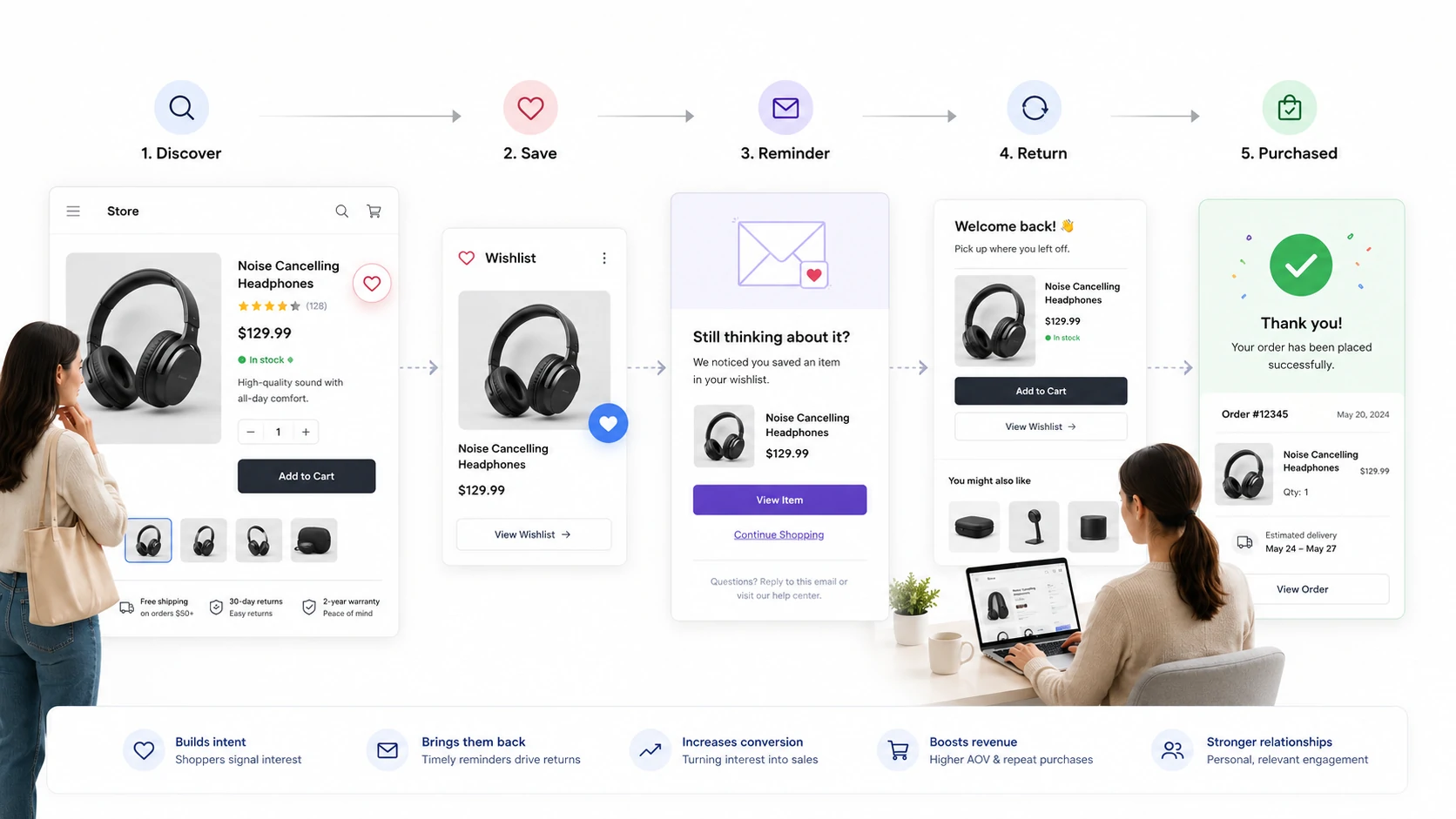
A wishlist turns saved product interest into a future reason to return.
What ecommerce stores can learn from Steam
Steam is a digital game marketplace, not a traditional ecommerce store.
But the buying behavior behind its wishlist system is familiar:
- Players discover games before they are ready to buy.
- Some users wait for reviews, launch dates, or discounts.
- Many people browse casually before making a decision.
- A wishlist gives them a personal place to save future purchases.
- Reminder emails bring them back when the timing is better.
Steam's own documentation explains that wishlists help players track games they are interested in and receive notifications when games release or go on discount.
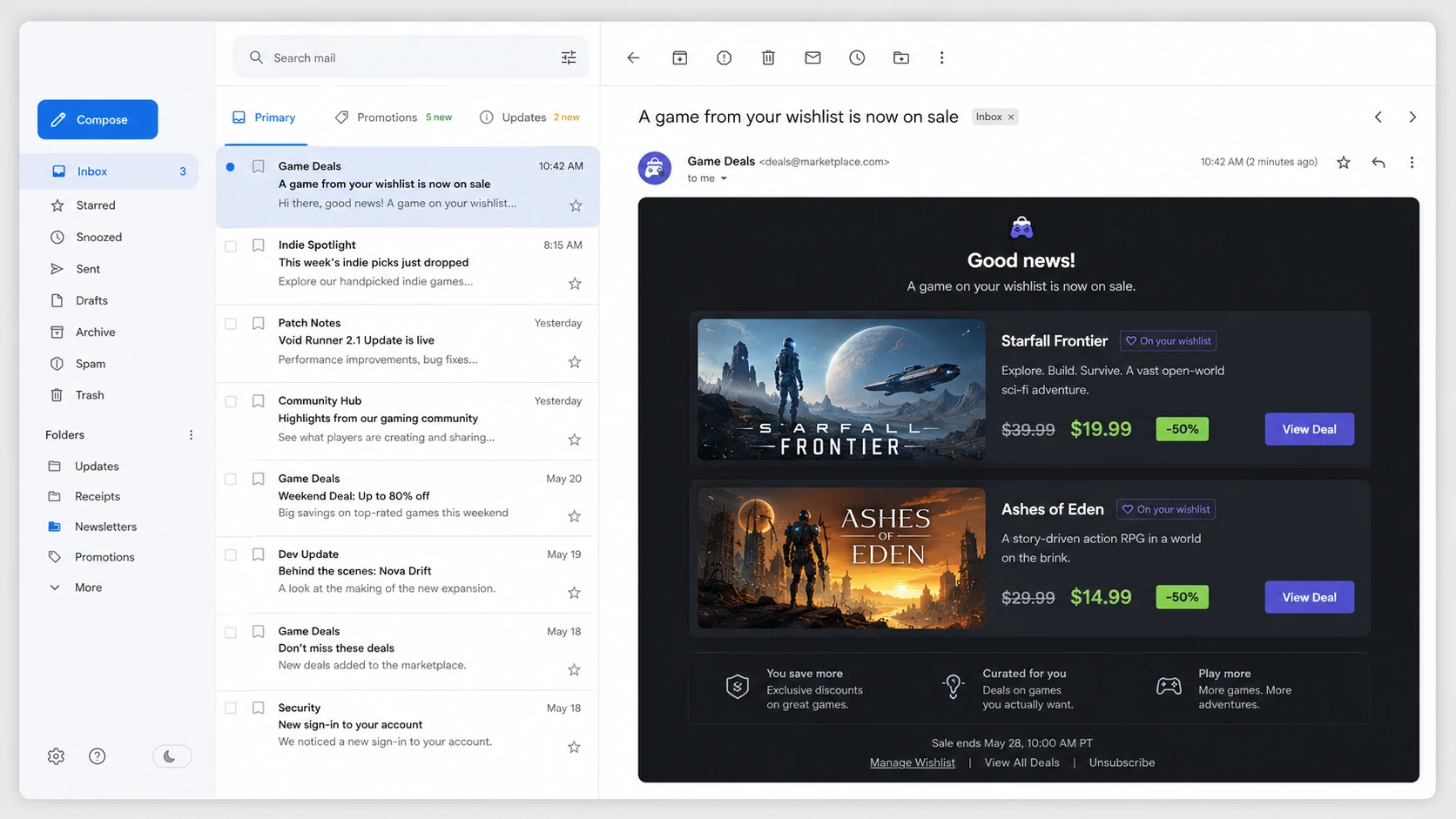
Wishlist reminder emails work because they are based on something the customer already saved.
References:
- Steamworks Documentation: Wishlists
- Steamworks Documentation: Wishlist Reporting
- Steam Wishlist Notifications
The lesson for ecommerce is simple:
A wishlist captures interest before a customer is ready to buy, and reminder emails help bring that customer back later.
1. Wishlists capture intent before checkout
Most ecommerce stores focus on two major actions:
- Product views
- Add to cart
But there is an important stage between those two actions.
A shopper can be interested in a product without being ready to add it to cart.
They may be comparing options.
They may be waiting for a sale.
They may be shopping for a gift.
They may be browsing on mobile and planning to buy later.
They may simply need more time.
Without a wishlist, that intent often disappears.
A product view says:
"Someone looked at this product."
An add-to-cart says:
"Someone may buy this soon."
A wishlist save says:
"Someone liked this product enough to save it."
That is valuable intent.
It shows that a shopper did more than browse. They made a small but meaningful decision to keep the product for later.
2. Wishlists make it easier for shoppers to return
Discovery is messy.
A shopper may browse many products in one session. They may compare styles, sizes, colors, prices, reviews, shipping times, or gift ideas.
Without a wishlist, they have to rely on memory, browser history, screenshots, or open tabs.
That creates friction.
A wishlist gives shoppers a simple place to return to.
For ecommerce stores, this can improve the shopping experience in practical ways:
- Customers can save products instead of searching again.
- Gift shoppers can build a shortlist.
- Fashion shoppers can compare items before buying.
- Jewelry shoppers can save higher-consideration products.
- Mobile visitors can return later from another device.
The easier it is for someone to return to a product, the more chances your store has to recover that intent.
3. Wishlist reminder emails turn interest into return visits
The most useful part of Steam's wishlist is not only that players can save games.
It is that Steam can remind them later.
A player may add a game to their wishlist and forget about it. Then, weeks or months later, an email arrives:
- The game is now on sale.
- The game has launched.
- The timing is finally right.
That email can turn old interest into a new purchase.
This is why wishlist reminder emails are powerful.
They are not cold emails.
They are not random promotions.
They are not generic newsletters.
They are based on a product the customer already chose to save.
For ecommerce stores, this pattern is extremely useful.
A customer may save a product and leave. Later, the store can bring them back when there is a real reason to return:
- A saved product goes on sale.
- A saved item is still waiting in their wishlist.
- A size or color comes back in stock.
- A seasonal campaign starts.
- A gift-giving moment gets closer.
- The customer needs a reminder before they forget.
This is different from a normal newsletter.
A normal newsletter says:
"Here are products we want to promote."
A wishlist reminder says:
"Here is something you already showed interest in."
That difference matters.
The reminder feels more relevant because the customer created the signal first.
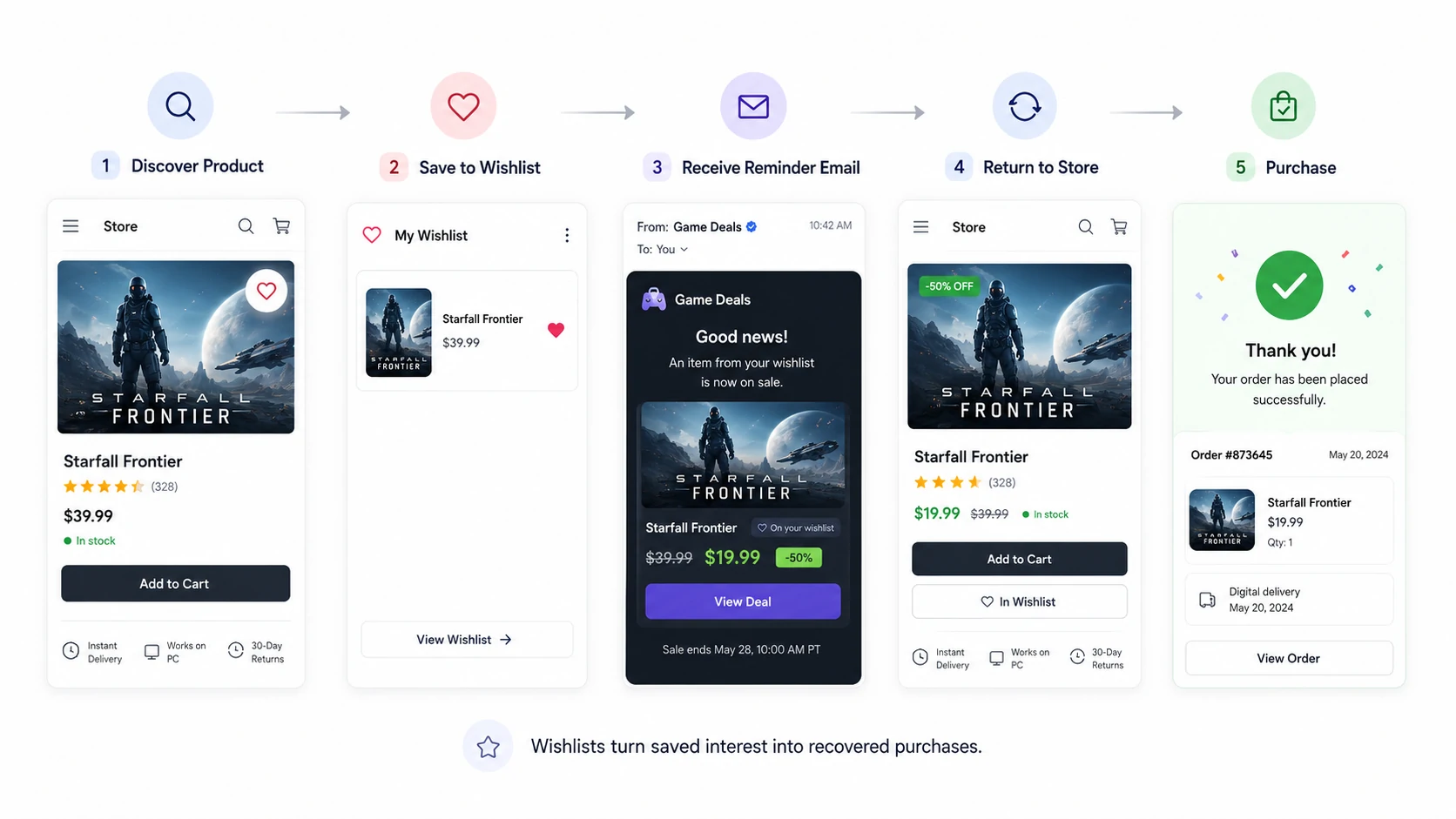
The wishlist flow: discover, save, remind, return, and purchase.
4. Discounts and timing make wishlists more powerful
Steam wishlists work well because many purchases are timing-based.
A player may not buy a game today, but they may buy when:
- The game launches
- The game goes on sale
- New reviews appear
- A seasonal sale starts
- They have more time to play
Ecommerce has similar timing moments.
A customer may save a product and return when:
- The item is discounted
- A size or color is back in stock
- A new collection launches
- A holiday gets closer
- They receive a reminder
- They are ready to complete the purchase
This is why wishlist data can be more useful than a simple page view.
A page view is passive.
A wishlist save is intentional.
When shoppers save products, they are giving the store a clearer signal of future demand.
5. Wishlist data helps stores understand demand
Wishlists are not only useful for shoppers. They are also useful for store owners.
Wishlist activity can help answer questions like:
- Which products are people interested in but not buying yet?
- Which items are saved often but rarely purchased?
- Which collections generate the most interest?
- Which products might be good candidates for promotion?
- Which saved products should be used in reminder emails?
- Which products should be restocked or featured?
This is especially useful when sales data does not tell the full story.
A product may not be selling well today, but many customers may be saving it.
That can mean customers like the product, but something is stopping them from buying.
Possible reasons include:
- The price is too high.
- Shipping cost is too high.
- A size or variant is unavailable.
- Product photos are not convincing enough.
- Customers are waiting for a discount.
- Customers are still comparing options.
- Customers need a reminder at the right time.
Wishlist saves give merchants another layer of purchase intent data.
They help stores understand not only what customers bought, but also what customers wanted before they bought.
6. Wishlist vs cart: why both matter
A wishlist and a cart are not the same thing.
They represent different stages of intent.
| Action | What it usually means |
|---|---|
| Product view | The shopper discovered or explored the product |
| Wishlist save | The shopper is interested and may return later |
| Add to cart | The shopper is closer to buying |
| Purchase | The shopper completed the transaction |
If a store only pays attention to carts, it may miss earlier purchase intent.
A wishlist helps capture the stage before checkout.
That stage matters because many shoppers are not ready to buy on the first visit.
7. What Shopify stores can apply from this
Most Shopify stores do not need a wishlist system as complex as Steam's.
But the core idea is the same:
When shoppers are interested but not ready to buy, give them a way to save that interest and a reason to come back later.
For a Shopify store, a good wishlist experience should make it easy to:
- Add a wishlist button to product pages
- Let shoppers save products with low friction
- Support guest shoppers who are not logged in
- Make the wishlist easy to find later
- Match the wishlist design with the store theme
- Understand which products customers are saving
- Send relevant reminder emails based on saved products
This is especially useful for stores selling products that people compare, save, gift, or buy later.
Examples include:
- Fashion
- Jewelry
- Beauty
- Gifts
- Home decor
- Collectibles
- Premium accessories
In these categories, the first visit is often about discovery. The purchase may happen later.
A wishlist helps bridge that gap.
8. How TValue Wishlist helps Shopify stores
TValue Wishlist helps Shopify merchants add wishlist functionality without editing theme code manually.
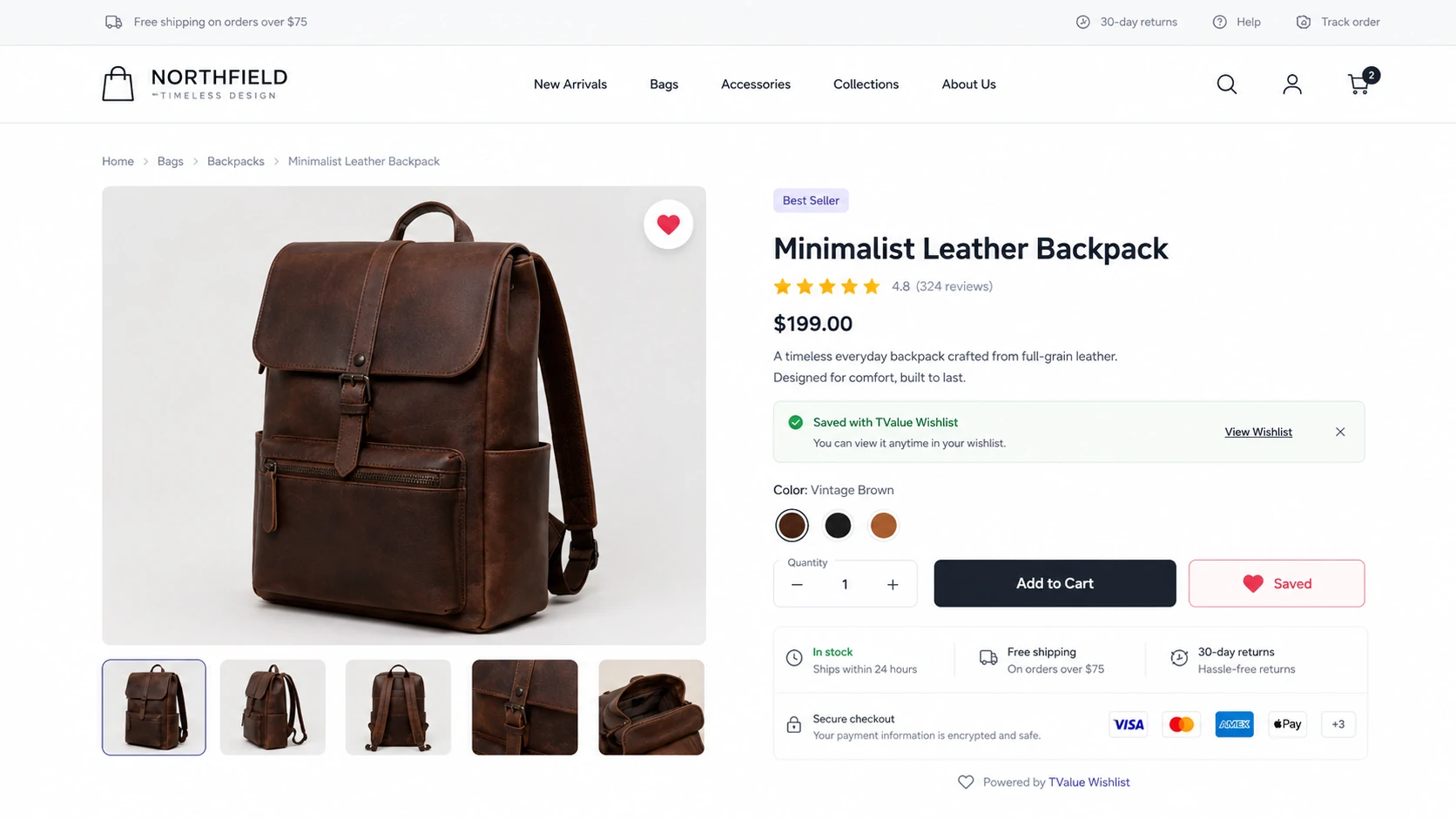
TValue Wishlist lets shoppers save products directly from the product page.
It is designed for stores that want a simple way to:
- Add wishlist buttons to product pages
- Support guest wishlists
- Customize the wishlist design
- Let shoppers save products for later
- Understand saved-product intent
- Bring shoppers back with wishlist reminder emails
The important part is not only the wishlist button itself.
The important part is what happens after a shopper saves a product.
A wishlist captures the signal:
"This customer is interested."
A wishlist reminder can turn that signal into a return visit:
"This product is still waiting for you."
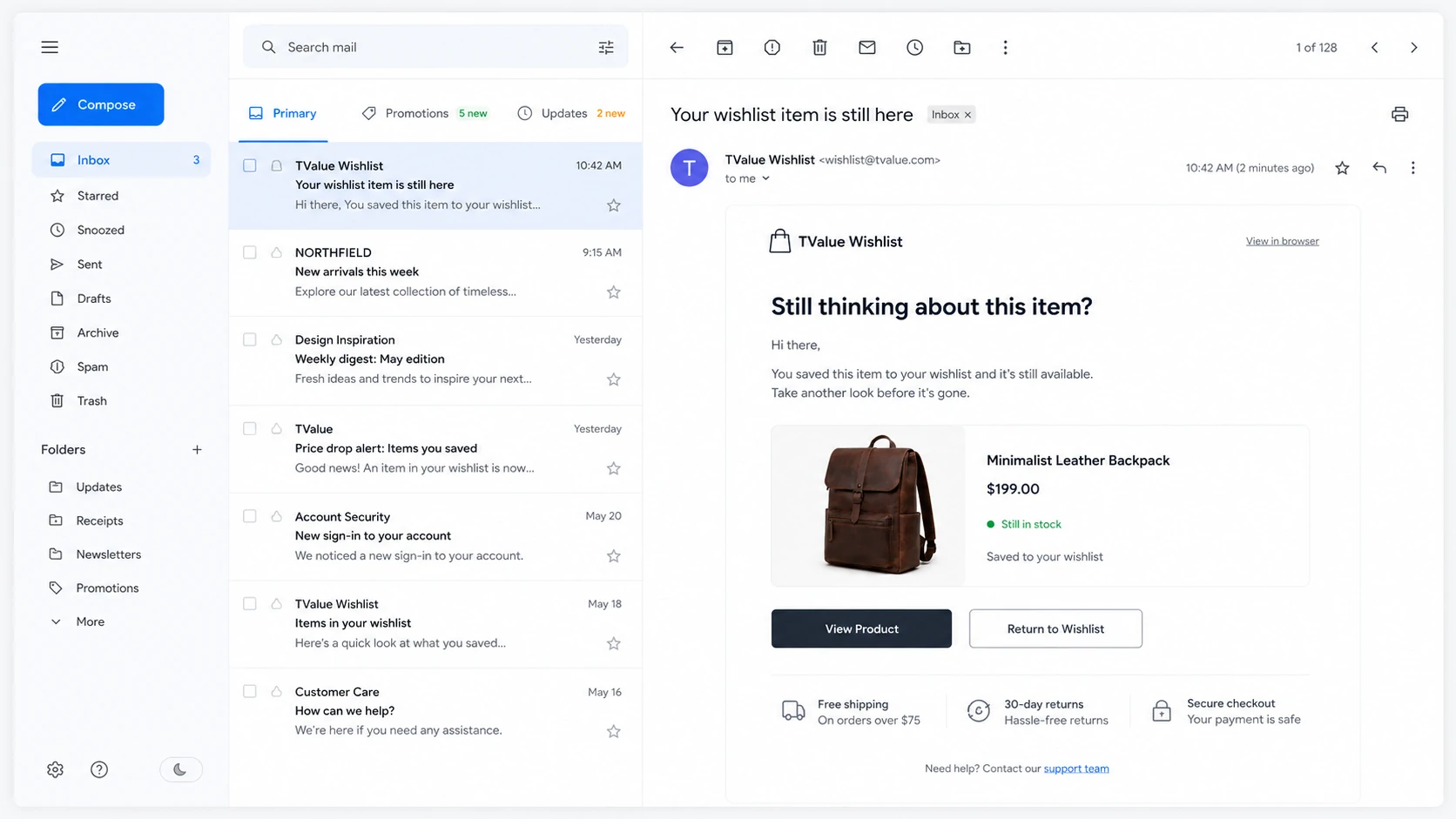
Wishlist reminder emails bring shoppers back to products they already showed interest in.
That is the same basic behavior that makes Steam's wishlist reminders so effective.
The customer already showed interest, so the follow-up feels timely and relevant instead of random.
If you want to add a wishlist to your Shopify store, you can install TValue Wishlist from the Shopify App Store:
Add TValue Wishlist to your Shopify store
FAQ
Why do ecommerce stores need wishlists?
Ecommerce stores need wishlists because many shoppers are interested in products before they are ready to buy. A wishlist lets shoppers save products for later and gives stores a way to capture purchase intent before checkout.
Why are wishlist reminder emails effective?
Wishlist reminder emails are effective because they are based on products the customer already saved. Instead of promoting random products, the store is following up on existing purchase intent.
How are wishlist reminder emails different from normal marketing emails?
Normal marketing emails usually promote products the store wants to sell. Wishlist reminder emails are based on products the customer already showed interest in, so they can feel more personal and relevant.
Are wishlists only useful for large marketplaces?
No. Large marketplaces like Steam show how powerful wishlists can be, but the same pattern works for smaller ecommerce stores. Any store with products that shoppers compare, save, gift, or buy later can benefit from a wishlist.
Is a wishlist better than a cart?
A wishlist is not better than a cart. It serves a different purpose. A cart is for near-term purchase intent, while a wishlist is for saving products before the customer is ready to buy.
What types of Shopify stores benefit most from wishlists?
Wishlists are especially useful for Shopify stores selling fashion, jewelry, gifts, beauty products, home decor, collectibles, premium products, or products with many variants.
Can customers use a wishlist without logging in?
That depends on the wishlist solution. A guest wishlist lets visitors save products before creating an account or logging in, which can reduce friction for first-time shoppers.
What is the easiest way to add a wishlist to Shopify?
The easiest way for most Shopify merchants is to use a wishlist app. TValue Wishlist lets merchants add wishlist buttons, support guest wishlists, customize the wishlist experience, and bring shoppers back with wishlist reminder emails.
Final thoughts
Steam shows that wishlists are powerful because they match how people actually buy.
People do not always purchase the first time they discover something. They browse, compare, wait, save, forget, and return when the timing is right.
Wishlist reminder emails make that return more likely.
For ecommerce stores, this is the real value of a wishlist.
It does not only help shoppers save products.
It helps stores bring shoppers back to products they already cared about.